
Why Paver Patios Sink in Minnesota (Freeze–Thaw Explained)
If your patio feels uneven, has sunken sections, or seems to get worse every spring, you’re not imagining it. Sinking paver patios are extremely common in Minnesota due to our freeze–thaw cycles. Understanding why this happens is the first step in deciding whether your patio needs a full repair or just a refresh.
Why Patio Pavers Sink or Shift Over Time
Paver patios rely on a stable base beneath the surface. In Minnesota, that base is constantly stressed by moisture, freezing temperatures, and soil movement.
Here’s what’s happening below your patio:
Water penetrates the joints and base material
Temperatures drop and that moisture freezes and expands
When it thaws, voids are left behind
Over repeated cycles, the base weakens and settles unevenly
Once the base loses integrity, the pavers above it begin to sink, tilt, or rock underfoot. This is why patios often look fine in the fall but feel noticeably worse after winter.
If the base has failed, surface-level fixes won’t last. This is where professional patio repair becomes necessary rather than cosmetic touch-ups.
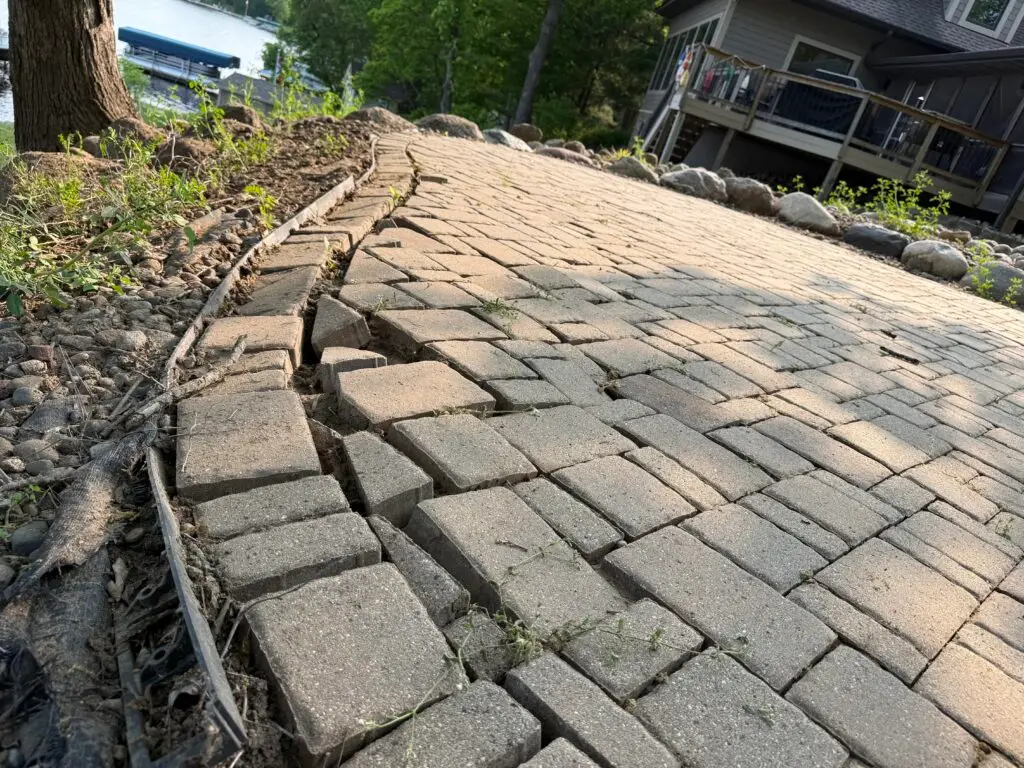
This patio shifted due to heavy erosion and weak paver edging installation.
What a Failed Patio Base Looks Like
Sunken or uneven pavers are usually a symptom of what’s happening underneath the surface.
Common signs of base failure include:
Low spots where water collects after rain
Pavers that rock or move when stepped on
Gaps opening up between joints
Sections that appear lower than the surrounding area
These issues typically indicate that the base material has shifted, washed out, or was never properly compacted to begin with.
Why Quick Fixes Usually Don’t Work
Many homeowners try quick fixes hoping to avoid a larger repair. Unfortunately, these solutions almost always fail over time.
Common short-term fixes that don’t last:
Sweeping sand into joints without fixing the base
Pressure washing to “clean it up”
Tapping pavers level without removing them
Ignoring edge restraint issues
Without addressing the underlying base problem, the patio will continue to move with each freeze–thaw cycle. The surface may look better temporarily, but the sinking will return.
When Patio Repair Makes Sense vs a Simple Refresh
Not every patio problem requires full repair. The key is knowing what you’re dealing with.
When Patio Repair Makes Sense
- Pavers are sunken, uneven, or rocking
- Water pools on the surface
- Sections have clearly settled lower than others
- The base has failed or washed out
In these cases, removing pavers, rebuilding the base, and properly compacting it is the only long-term solution.
When a Patio Refresh Is Enough
- Pavers are level but joints are worn
- Weeds or ants are present
- Surface looks dull or dirty
A refresh may include pressure washing and re-sanding with polymeric sand to restore appearance and joint stability.
How Add-Ons Improve Long-Term Results
Once the base is properly repaired, the right finishing details make a big difference in longevity.
Upgrades that help patios last longer:
Polymeric sand to lock joints and reduce washout
Steel edging restraints to prevent lateral movement
Proper surface grading for water runoff
These additions don’t replace base repair, but they significantly extend the life of a properly fixed patio.
Patio Repairs in Minnesota’s Freeze–Thaw Climate
Minnesota patios face unique challenges compared to warmer regions. Freeze–thaw cycles, heavy spring moisture, and soil movement all contribute to paver shifting over time.
We regularly complete patio repairs throughout Minneapolis, Saint Paul, and surrounding Minnesota communities where these conditions are unavoidable. Repairs done correctly are designed to handle these seasonal changes, not fight against them.